Pages

Monday, September 3, 2018

O-I Superheavy Tank: A Complete History


The Battle of Khalkhin Gol had been a devastating defeat for the Empire of Japan in 1939. The Kwantung Army suffered total strategic defeat at the hands of the Soviet Union surrounding the village of Nomonhon. This had been Japan’s first significant deployment of armour against a modern army. Tank development in Imperial Japan was still in its nascent stages by the time the border conflict at Nomonhon began.


Notebooks belonging to the engineers working on the O-I/Mi-To tank project, and
where majority of the source material from this write-up derived from, including all drawings.


Saturday, August 25, 2018

Tank Battle of Khalkhin Gol

It was the eve of June 20th, and the Japanese headquarters in Manchukuo enacted emergency mobilization of the 3rd and 4th Tank Regiments. Soviet armies moved alongside the Manchurian border, preparing to retaliate for the border skirmish between Mongolian calvary units under supervision of the Soviet Union, and Manchurian infantry regiments. A border dispute between two puppet states forced the response of the Empire of Japan and Soviet Union to mobilize their borders.


Japanese Tank Regiment's pushing around the Harzha River to the frontline.


Friday, October 6, 2017

Ohka-based Interceptor Fighter

Recently I spent some time in the National Archive of Japan and the National Diet Library Center. I eventually found, with help of a friend procuring documents from the Canadian Heritage archive, a new type of Japanese interceptor based on the Ohka Suicide Bomb. I don't usually touch on aircraft, as my aerial knowledge is rather poor. To make this I worked with a few people who have a much better understanding than myself. Such as Cherryblossom, ARADO_AKBAR, Shapeshifter (Whelmy), and Leo Guo.

Friday, June 23, 2017

Through the Gauntlet

It is not often you hear of Japanese war heroes during the War in the Pacific. Due to their reputation, many cases of Japanese bravery went unnoticed as the years went on. Often set aside to instead forget about the tragedies and brutal events that took play throughout the Second World War. However if any account of bravery is to be known, it is the actions of a single tank commander of the Imperial Japanese Army during the Battle for Iwo Jima. A man who took personal responsibility and dared to do the unthinkable to protect his comrades when all had seemed lost. The Battle for Iwo Jima had been one of the most brutal and bloody battles of the war. Japan's last hope of defense against the invading American forces, who needed the island in order for its long range bombers to reach the home island of Japan.


Saturday, April 1, 2017

High-Voltage Dynamo Tank


  Visiting the National Archives as of late has been rather unfruitful. I've found myself finding less data for my current research projects and more on Japan's oddities throughout the war. Last week, I came across a private file in the archive which contained a series of the military's secrets during the period. Secret tank and weapon projects to battle the Allies and support a triumphant victory to end the war. The file was labeled "High Voltage Dynamo Vehicle" Ref. A06033400540.  This had caught my eye, and I spent a day and half analyzing its contents. What I found was fairly odd, and today I wanted to share the Japanese tank project that would have changed the war in the Pacific.

A Young Kesuke Miyagi.
As tensions began to wise globally during the late 30's, Japan knew a new war was closely approaching. Tank development in the nation  had only recently begun, whilst other nations were far ahead in the tank production race. Japan sought other alternatives, ones which relied on science to give Japan their much needed edge. A Japanese science professor and engineer, by the name of Kesuke Miyagi, proposed a solution to Japan's needed problem. Miyagi had studied in the United States during the 20's and 30's as a colleague of Nikola Tesla, the engineer who developed widespread use of electric power. During Miyagi's time in the States, he studied with other scientific minds in developing use of electric energy in the modern world. Miyagi took inspiration off  one of Tesla's designs for an electric ray gun that the Unites States had asked Tesla to construct for the military. It was brought to the Japanese in mid 1937 when Miyagi returned back to Japan to attempt getting his new design for military use to be used within the military.

National Archive File Ref. A06033400540 "High Voltage Dynamo Vehicle".
  
Kesuke Miyagi's design proposal had been accepted in the June of 1938. However it had been delayed soon after due to the Nomonhan Incident with the Soviet union the following year. After Japan's blatant defeat in Manchuria, the high command grew desperate for a weapon to change the tide. The command gave the order to construct the electric repulsion cannon. The cannon was built in prototype form in 1939, and after successful trials entered service under the Military as the Type100.


Prototype Tank

Ka-Ha Prototype during trials. 
 The Japanese high command became fond of the ray gun, and in 1940 ordered for its use in the field. Placed under the 3rd Technical Research group, the Type100 had been decided to be implemented within the chassis of a modified Type97 Chi-Ha tank. To accommodate the need for a specially built electric generator for the gun, the Chi-Ha hull had to have been raised changing the tank's height to 4.12 meters. The generator ran off of diesel, and was able to produce up to 300 million volts, amounting to the common lightning bolt in electric power. No vehicle of the era amounted to the tank's power output, and had been considered a milestone in electrostatic repulsion.

After 6 months the first prototype had been completed. It had been given the name of the Ka-Ha, and was able to complete trials without fail. It was tested against captured Vickers 6-ton tanks captured in Shanghai. The cannon had been capable of tearing apart large holes in the tank’s structures with the electric force. The trial runs showed to Japan the power the tank had been capable with. It was ordered for the tank to be mass produced immediately sent to the field.


Combat Usage

By 1943, four units of the Ka-Ha Voltage tank were manufactured.  Due to the demanding generator needed to power the Type100 electrostatic repulsion cannon, the Japanese lacked the sufficient resourced to produce the Ka-Ha on the projected scale required. This was seen as unacceptable to the high command, who viewed the Ka-Ha as the key to success during the war. To counter this, a series of vehicles were made with lower output generators, from 400-10000 volts that were used in China. They were to fire on telephone lines and disable and kill partisans relaying Japanese positions to the Nationalist Army.

A destroyed Cruiser tank with a ruptured hull
from the blast of the Ka-Ha tank. 
For the 4 units of the Ka-Ha that maintained the original Type100 cannon, they were deployed in Burma regions. Most combat was seen in Burma during the British advances in the South to recapture the occupied territories Japan had taken during the initial stage of the war. Due to the monsoon rains that took place during the campaign, it offered the Japanese a vast superiority of the British when using the Ka-Ha in the field. With the rain amplifying the power of the Type100, whole groups of Cruiser and Matilda tanks were annihilated during their advances. While Britain had been able to ultimately push Japan away from Burma, the losses at the hand of the Ka-Ha reached varying numbers of 10-23 armoured vehicles vehicles.


Wednesday, March 15, 2017

Theorem on Newly Discovered Tanks


   As of late, I have uncovered photos of Japanese tank training in Manchuria sometime in 1937 at a photograph auction. At first I regarded this as just another photographed album of pictures of the inter-war period, but, looking through the album, I came across a photo which deeply intrigued me. Two tanks of unknown design, being tested climbing a rise in the fields outside the Manchurian Tank School. At first glance, I had presumed them to be both Chi-Ha tanks as they fit the typical Japanese medium tank style. Further analysis, however, made me believe that these were not Chi-Ha tanks, rather, two brand new designs of tanks as yet unknown. Consulting with some of my colleagues on this, I have since connected some dots in Japanese tank development history that were previously left unnoticed with the research community. Here today I present my new thesis regarding the steps the Japanese most likely took when producing their tanks.

Two New Medium Tanks I recently discovered through a photograph auction. 


Nomenclature

The Empire of Japan, like other nations, had their own style of classifying things in the military. Japan used the Imperial Calendar when naming weapons and vehicles in the military under the year of enacted service or construction. It emphasized using the last two (or three) digits of the given year as a Type in number form. A common example of this was the Type 95 Ha-Go tank. The Type refers to the fact the given vehicle belonged to the military. The two digit number following the Type meant that the tank was built in 1935 (Imperial Year 2595). This was standard issue for all things in the military, and would follow through to even the current year.

Type 95 Heavy "Ro-Go".
Prior to the Battle of Shanghai in 1937, the Japanese used a specialized system for labeling tanks. Instead of using a class system to label tanks under specific weight groups like Light, Medium, Heavy, etc, they merely used the order in which they were built. The first Japanese tank built in significant numbers had been the Type 89 I-Go, produced in 1929. It had been the Japanese tank that began mass production for the military, and was named accordingly. I-Go is translated to First Domestic Tank in the Japanese Army. “I” representing First, and “Go” for Domestic [vehicle]. This had been applied to produced tanks until 1937. Three known tanks used this system;

I-Go: First Domestic Tank
Ro-Go: Second Domestic Tank
Ha-Go: Third Domestic Tank

The Ro-Go is commonly known as the Type 95 Heavy Tank. Until 2015, the heavy tank was simply referred to as a heavy tank due to no found naming term applied to it. However discoveries with the O-I documentation release confirmed the tank was given the name Ro-Go, as it was the second tank in Japan produced in numbers outside one or two. It was never labeled as a heavy tank in name, only in its description. Hence the common theory arose that the tank was only referred to as the Type 95 Heavy, instead of the proper name Ro-Go. Other tanks such as the Type 94 Te Ke were not included in this nomenclature due to being a tankette, classified as an armoured car. Hence only three tanks were given naming.

Starting in 1937, the Japanese enacted this new nomenclature starting with the Chi-Ha tank, with the new system being  called the Iroha Naming Convention. Replacing the previous system where tanks were named in their domestic order, they were instead classed under their weight and the number in which they followed through in order. The Chi-Ha, for instance, is translated as “Third Medium” in the army. Other tank classes were given their own names in Kanji and the respective numbers:

Weight Terms:
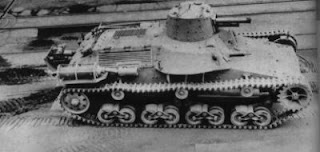
Chi-Ni Medium Tank. 

Ke: Light
Chi: Medium
Ho: Gun Tank
Ju: Heavy
O: Super Heavy
Shi: Car

Numbering:
1: I
2: Ro
Chi-Ha Medium Tank.
3: Ha
4: Ni
5: Ho
6: He
7: To
8: Chi
9: Ri
10: Nu
11: Ru
12: O


Popular Examples of the Iroha system:

Ke-Ni: Fourth Light
Chi-Nu: Tenth Medium
O-I: First Super Heavy
Chi-Ri: Ninth Medium


Holes in History

The glaring issue with this system was that the Chi-Ha had been labeled the Third Medium tank, despite there being no First and Second Medium tank (I and Ro). Many historians came to the commonly agreed upon conclusion that since the system was only applied to tanks produced from 1937 onwards, the vehicles prior to this were not given the integrated naming change. Japan had produced two medium tanks with the old classification system, the Experimental I tank, which was classed as a medium-like tank, and the Type 89 I-Go. With no knowledge of any other tanks, it was believed the Japanese considered these two tanks the predecessors of the Chi-Ha, and falsely labeled the Experimental I and I-Go tanks as the “Chi-I” and “Chi-Ro” tanks respectively.

Of course, there were problems in this common interpretation that were left unanswered. The Type 98 Ke-Ni, dubbed the Fourth Light Tank, was the first Japanese light tank design  with the new Iroha classing nomenclature. The Ha-Go, which was referred to as the Third Domestic light tank in Japan, had too been incorrectly placed before the Ke-Ni in the Iroha naming system. This left a gap in light tank development that had simply been left unfilled. The lack of documented records with early Japanese tank history had given many historians decades later the trouble of securing a firm timeline of tank development and naming.

Tank "A".
As I mentioned earlier, two new tanks were found that did not match known tanks of the Japanese military. The fact that these two tanks existed in 1937, and had not been commonly known to the world only connects the hiccups in the applied Iroha system. These two tanks, which I for now I will refer to as Tank “A” and Tank “B”, logically fill the spots for the First and Second Medium tank naming that was incorrectly put with the Experimental and I-Go. During the mid ‘30s, Japan began developing a medium tank to became the new battle tank to support the infantry in the field. A series of prototypes were proposed take the spot. The two most known were the Chi-Ha and Chi-Ni tanks. While the Chi-Ha took the role, the Chi-Ni was labeled as the Fourth Medium tank as it was built after the Chi-Ha. However if these two tanks are in fact mediums that were also considered for the role, it is safe
to presume them to be the first series of tanks to compete for
 the role as Japan’s new battle tank.

Tank "B". 
One of my work colleagues, by the name of David Lister (Listy), had two years ago, uncovered more tanks that were produced in Japan during the interbellum period. Hidden within the British archives were a series of heavy and light tanks that according to documents of multiple nations (such as Britain, Japan, Sweden, Australia, America, and Russia) were produced in small numbers and serviced throughout the Chinese mainland and Pacific islands. With these tanks are three light tanks, all supposedly built. If the two tanks I uncovered are truly the Chi-I and Chi-Ro, this even further supports the theory as the three light tanks fit perfectly into the Iroha system where the Ke-Ni is the Fourth Light, with no known predecessor to fit the first three spots as circumstantial evidence supporting my theory.

In this new proposed theory, every spot in the Iroha classing system falls into their proper order up until the 1944-1945 gap where many tanks were scrapped and remain unknown.

Chi-I:  (Medium First) Tank “A”
Chi-Ro:  ( Medium Second) Tank “B” 
Chi-Ha: ( Medium Third) Type 97 Chi-Ha
Chi-Ni: (Medium Fourth): Type 97 Chi-Ni
Chi-Ho: (Medium Fifth) Type 98 Chi-Ho
Chi-He: (Medium Sixth): Type 1 Chi-He
Chi-To: (Medium Seventh): Type 4 Chi-To
Chi-Ri: (Medium Ninth): Type 5 Chi-Ri
Chi-Nu: (Medium Tenth): Type 3 Chi-Nu

Ke-I: (Light First) Unreleased Tank*
Ke-Ro: (Light Second) Unreleased Tank*
Ke-Ha: (Light Third) Unreleased Tank*
Ke-Ni:  (Light Fourth) Type 98 Ke-Ni
Ke-Ho: (Light Fith)  Type 5 Ke-Ho
Ke-He: (Light Sixth) Currently Unknown
Ke-To: (Light Seventh) Type 2 Ke-To
Ke-Ri: (Light Ninth) Type 3 Ke-Ri
Ke-Nu: (Light Tenth) Type 4 Ke-Nu

Ju-I: (Heavy First) Type 96 Heavy*
Ju-Ro: (Heavy Second) Type 97 Heavy*
Ju-Ha: (Heavy Third) Mitsu-104*
Ju-Ni:  (Heavy Fourth) Ishi-108*

* = Tanks currently not publicly available. Kept private with David Lister and I until his book, which was recently contracted, is published.


Sunday, March 5, 2017

O-I Size Comparisons

While I finish up the next history article for you guys, Here is something interesting for those curious about the O-I superheavy tank. I've put together a few diagrams comparing the size of the O-I with popular tanks of other nations many are familiar with.

Built in 1943, the O-I tank was one of the largest armoured vehicles produced, dwarfing even the notorious Tiger tank serviced in Germany during the Second World War. The tank had a height of 3.63 meters, a length of 10.12 meters, and a width of 4.84 meters. The dimensions of the vehicle closely matched those of the Panzer VIII Maus. These proportions were massive and required the equally large amount of crew to operate it. The crew consisted of 11 manned positions. These were; 1 Driver, 1 Co Driver, 3 Main turret gunners, 1 Commander, 2 secondary turret operators, 1 rear turret operator, 1 Radio signaler, and 1 Engineer to maintain the tank. It maintains one of the highest crew count for any produced tank.


O-I with the Tiger I tank (Front View)


O-I, Maus, T-95 (Front View)


O-I, Maus, T-95 (Side View)


O-I and Type95 Ro-Go heavy (Side View)


Context

If someone came to you and asked the question; "what comes to mind when you hear the term super-heavy tank?", the average answer would be the notorious Maus or E-100 respectively. Big clunking tanks with large slabs of thick steel and armed with monstrous cannons. The idea of this class of vehicle had lingered on since the First World War, often relegated to the domain of prototypes and experimental designs. It would not be until the inter-war period that the concept captured designers' imaginations and drawing-boards as the 'next big thing' to turn the tide in the wars to come. Japan was no exception; in the dawn of the 40's, this super heavy tank would be known to the public as the O-I.

History: http://sensha-manual.blogspot.com/2016/10/too-big-to-stop-too-heavy-to-start_16.html


The O-I was conceived out of the necessity to produce a mobile bunker to contest the Soviet Union in the then-expected Second Russo-Japanese conflict. The flaw with the routine bunker or pillbox is that you cannot maneuver and relocate them with the frontline constantly being pushed. Japan would need a sustainable fortress that could push with the infantry and advance further into the USSR without the need to construct more immobile bunkers with resources already scarce.

Characteristics: http://sensha-manual.blogspot.com/2016/10/between-bolt-and-hard-place.html